SETI (Search for Extra-Terrestrial Life)
The Search for Extraterrestrial Intelligence (SETI) is the scientific effort to detect evidence of intelligent life beyond Earth. Researchers search for extraterrestrial radio signals, optical laser emissions, and possible alien artifacts that could reveal the presence of advanced civilizations. Some initiatives have also attempted to send messages into space, including NASA's Golden Record.
Modern SETI emerged in the early 20th century with the development of radio technology and has since expanded through pioneering projects such as Project Ozma, the discovery of the Wow! signal, and Breakthrough Listen—a $100 million, 10-year initiative announced in 2015 by Stephen Hawking and Yuri Milner to search nearby stars for signs of intelligent life. Since the 1980s, international programs and citizen-science projects, including SETI@home and Project Argus, have enabled researchers and volunteers worldwide to analyze enormous amounts of astronomical data.
Although SETI is a well-established scientific field built on rigorous methods and verifiable data, it is often unfairly associated with conspiracy theories and UFO research, leading to unwarranted public skepticism. At the same time, scientific investigations into unidentified aerial phenomena (UAP), such as Avi Loeb's Galileo Project, have renewed interest in the broader search for extraterrestrial intelligence.
After decades of searching, SETI has yet to find confirmed evidence of intelligent alien life. Critics argue that the field is speculative and difficult to falsify, while supporters maintain that it is an essential scientific endeavor that could help resolve the Fermi paradox and uncover the first evidence of extraterrestrial technosignatures.
Humanity's search for intelligent life beyond Earth began long before modern SETI.
In 1896, Nikola Tesla proposed that an advanced version of his wireless transmission system could be used to communicate with inhabitants of Mars. Three years later, while conducting experiments at his Colorado Springs laboratory, Tesla believed he had detected a repeating signal from the Red Planet after noticing an unusual static pattern that disappeared when Mars set below the horizon. Later analyses suggested several possible explanations: Tesla may have misunderstood the new radio technology, intercepted transmissions from Guglielmo Marconi's European experiments, or detected naturally occurring radio emissions produced by Io, one of Jupiter's moons, interacting with Jupiter's magnetic field.
During the early 1900s, Guglielmo Marconi, Lord Kelvin, and David Peck Todd also suggested that radio could be used to communicate with Mars. Marconi even claimed his radio stations had received possible Martian signals.
Interest peaked during Mars' exceptionally close opposition on August 21–23, 1924. The United States observed a 36-hour "National Radio Silence Day," during which radio stations paused transmissions for five minutes every hour to reduce interference. At the United States Naval Observatory, a radio receiver suspended beneath a dirigible nearly 3 kilometres (1.9 miles) above the ground listened for signals using a "radio-camera" developed by Charles Francis Jenkins and Amherst College. The project was led by David Peck Todd, supported by Admiral Edward W. Eberle, while Army chief cryptographer William F. Friedman was assigned to decipher any potential Martian messages.
A major turning point came in 1959 when Philip Morrison and Giuseppe Cocconi published a landmark paper proposing that scientists search the microwave region of the radio spectrum for extraterrestrial communications. They also identified promising frequencies and suggested the first realistic search targets.
The following year, Frank Drake conducted the first modern SETI experiment, Project Ozma, named after the Queen of Oz from L. Frank Baum's novels. Using a 26-metre (85-foot) radio telescope at Green Bank, West Virginia, Drake searched the nearby stars Tau Ceti and Epsilon Eridani near the 1.420 GHz "water hole" frequency, located between the spectral lines of hydrogen and hydroxyl. A 400-kilohertz band was scanned with a 100-hertz receiver, but no extraterrestrial signals were detected.
SETI also gained momentum in the Soviet Union during the 1960s. Soviet researchers carried out numerous searches using omnidirectional antennas, while astronomer Iosif Shklovsky published the pioneering book Universe, Life, Intelligence (1962). The work was later expanded by Carl Sagan into the influential bestseller Intelligent Life in the Universe (1966).
Meanwhile, in 1955, John D. Kraus outlined plans in Scientific American for a large radio telescope designed to search for natural
cosmic radio signals. His proposal was approved by Ohio State University, and construction soon began on the Big Ear radio telescope in Delaware, Ohio. Built with US$71,000 in National Science Foundation funding (about US$814,000 in 2025 dollars), Big Ear later became home to the world's first continuous SETI effort, the Ohio State University SETI Program.
In 1971, NASA funded an ambitious SETI study involving Frank Drake, Barney Oliver of Hewlett-Packard Laboratories, and other leading scientists. Their report proposed Project Cyclops—a massive Earth-based array of 1,500 radio dishes with an estimated cost of US $10 billion. Although Cyclops was never built, its concepts heavily influenced nearly every major SETI project that followed.
The Wow! Signal
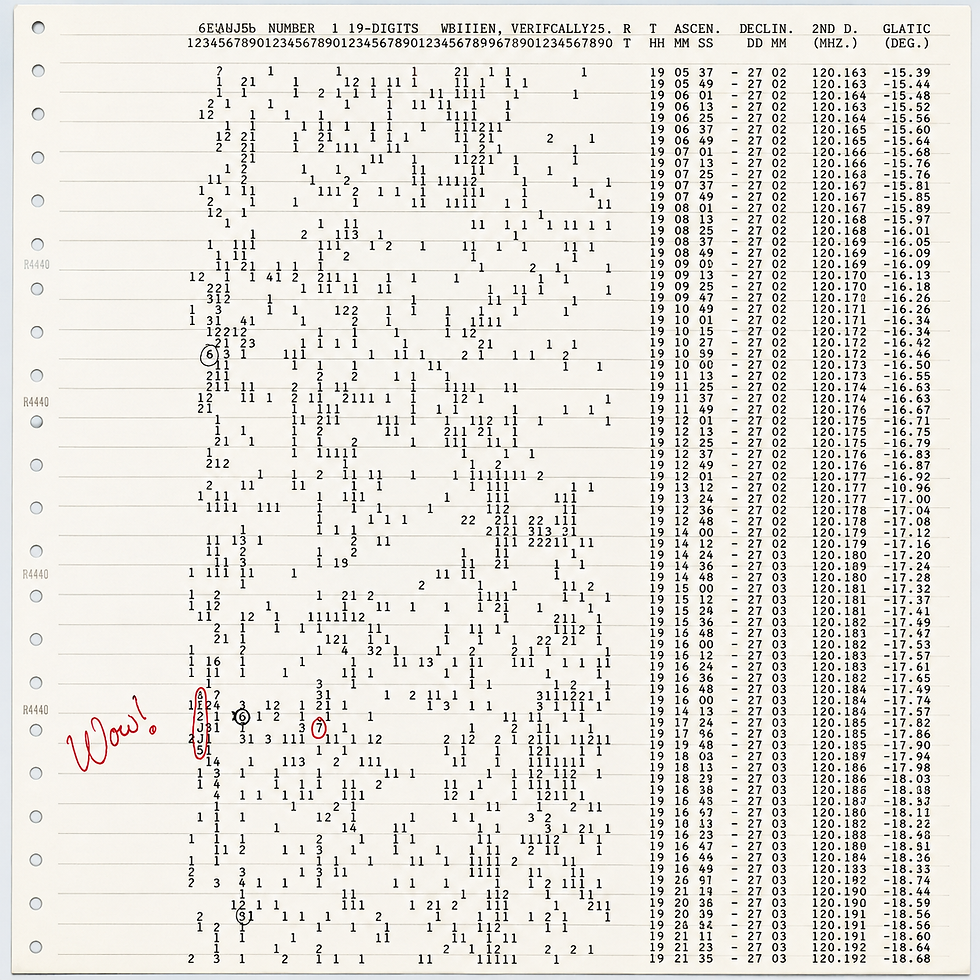
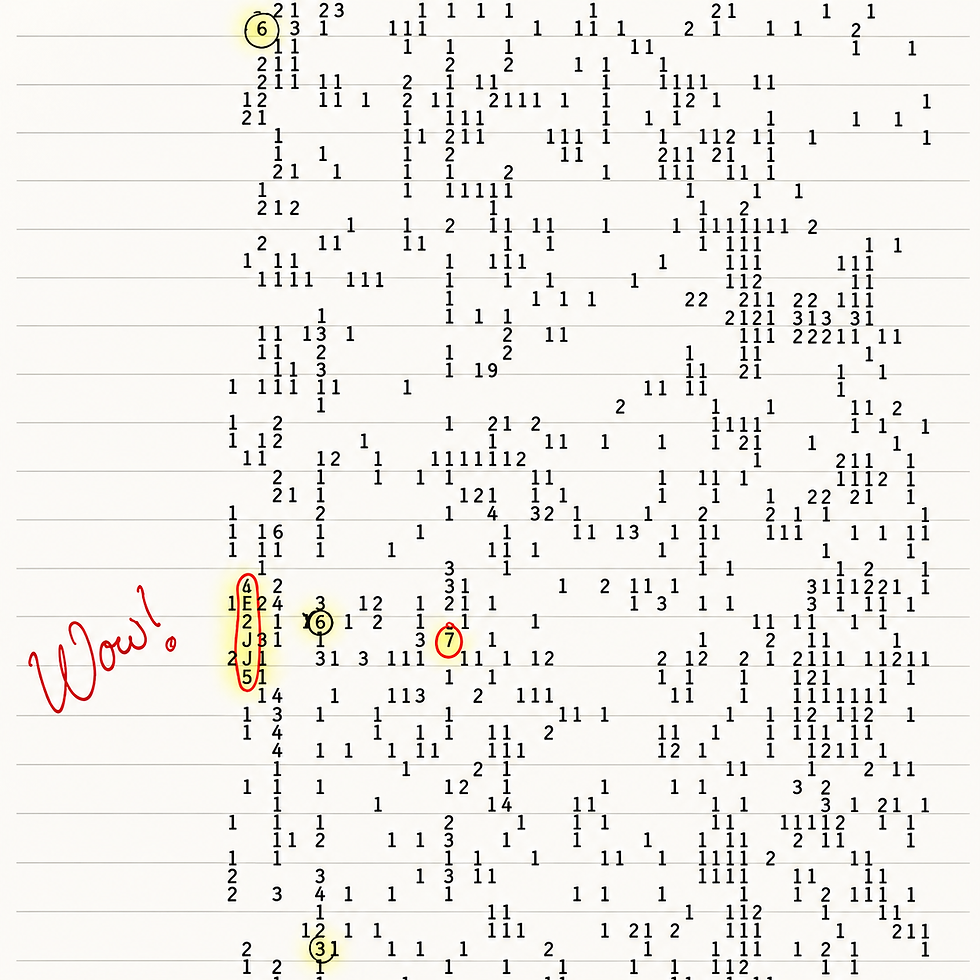
The Ohio State SETI Program achieved worldwide recognition on August 15, 1977, when volunteer astronomer Jerry Ehman discovered an unusually powerful radio signal while reviewing telescope data. Surprised by its strength, he circled the signal on the printout and wrote "Wow!" in the margin, giving the event its famous name.
The Wow! signal remains one of the strongest candidates ever detected for a possible artificial extraterrestrial radio transmission. However, despite numerous follow-up observations over the decades, the signal has never been detected again, leaving its true origin a mystery.
On May 24, 2023, scientists conducted a very different experiment by transmitting a simulated coded radio message from Mars to radio telescopes on Earth. The exercise was designed to test how researchers might decode a genuine extraterrestrial transmission.
Describe your image
Describe your image
Describe your image
Sentinel, META, and BETA
In 1980, Carl Sagan, Bruce Murray, and Louis Friedman founded The Planetary Society, which became an important supporter of SETI research.
Around the same time, Harvard physicist Paul Horowitz recognized that conventional spectrum analyzers were too limited for an effective search for extraterrestrial signals. Using advances in digital signal processing, he developed Suitcase SETI, a portable analyzer capable of monitoring 131,000 narrowband channels simultaneously. After successful field tests, it entered service in 1983 on the 26-metre (85-foot) Harvard/Smithsonian radio telescope at Oak Ridge Observatory in Massachusetts as Project Sentinel, which operated until 1985.
To dramatically increase search capability, Horowitz launched Project META (Megachannel Extra-Terrestrial Assay) in 1985. META expanded the search to 8.4 million channels with an exceptionally fine 0.05-hertz resolution. One of its key innovations was the use of Doppler shift analysis to distinguish potential extraterrestrial signals from terrestrial interference. Supported by The Planetary Society and partially funded by filmmaker Steven Spielberg, META later expanded into the Southern Hemisphere with META II, established in Argentina in 1990 and upgraded in 1996–1997.
META was eventually succeeded by BETA (Billion-channel Extraterrestrial Assay), which began observations on October 30, 1995. BETA represented a major leap in computing power, using 63 dedicated fast Fourier transform (FFT) processors and 21 custom-equipped computers to monitor 250 million simultaneous channels at 0.5-hertz resolution. It surveyed the microwave spectrum from 1.400 to 1.720 GHz, automatically re-observing promising signals with adjacent telescope beams to determine whether they moved across the sky at the rate expected for an extraterrestrial source. A third receiver continuously monitored the horizon to eliminate
terrestrial interference.
BETA's mission ended abruptly on March 23, 1999, when the 26-metre radio telescope used by Sentinel, META, and BETA was destroyed by powerful winds, forcing the project to shut down.
MOP and Project Phoenix
SETI's relationship with government funding has been turbulent. In 1978, Senator William Proxmire criticized NASA's SETI program, leading Congress to eliminate its funding in 1981. Funding was restored a year later after Carl Sagan successfully argued for the program's scientific value.
In 1992, NASA launched the Microwave Observing Program (MOP), the first fully operational government-funded SETI search. MOP combined an all-sky survey with targeted observations of 800 nearby stars, using radio telescopes from the NASA Deep Space Network, the Green Bank Observatory in West Virginia, and the Arecibo Observatory in Puerto Rico. Powerful spectrum analyzers processed up to 15 million channels, with 1-hertz resolution for targeted searches and 30-hertz resolution for the all-sky survey.
Despite its scientific promise, MOP was canceled by Congress after just one year. Determined to continue the search, the nonprofit SETI Institute revived the program in 1995 under the name Project Phoenix, funded entirely through private donations.
Directed by Jill Tarter, Project Phoenix continued MOP's targeted search strategy, examining approximately 1,000 nearby Sun-like stars through about 2015. Between 1995 and 2004, the project conducted observations using the Parkes Radio Telescope in Australia, the Green Bank Telescope, and the Arecibo Observatory, effectively surveying around 800 stars across frequencies from 1.2 to 3.0 GHz. The system was sensitive enough to detect a transmitter with an effective radiated power of 1 gigawatt (GW EIRP) from distances of roughly 200 light-years.
By 2012, the SETI Institute was spending approximately US$2 million annually on its own SETI research, while global SETI efforts collectively required roughly ten times that amount each year.
Ongoing Radio Searches
Radio waves are central to the search for extraterrestrial intelligence because many frequencies pass through Earth's atmosphere with little interference. Large radio telescopes scan the sky for narrowband, repetitive signals that could indicate an artificial origin.
For more than a century, Earth itself has been broadcasting radio and television signals into space. These transmissions have already reached more than 1,000 nearby stars, including Vega, Aldebaran, Barnard's Star, Sirius, and Proxima Centauri. If intelligent civilizations exist around these stars, they could potentially detect and decode our broadcasts, although Earth's ionosphere slightly distorts some of the signals.
Today, radio SETI observations are carried out using major observatories around the world, including the Low Frequency Array (LOFAR) in Europe, the Murchison Widefield Array (MWA) in Australia, and the Lovell Telescope in the United Kingdom.
Allen Telescope Array (ATA)
To create a radio telescope dedicated to SETI, the SETI Institute partnered with the Berkeley SETI Research Center to build the Allen Telescope Array (ATA) at Hat Creek Radio Observatory in northern California. Originally called the One Hectare Telescope, it was later renamed in honor of Microsoft co-founder Paul Allen, whose financial support helped make the project possible.
The completed design, known as ATA-350, calls for more than 350 offset-Gregorian dishes, each measuring 6.1 metres (20 feet) in diameter. Together, they would provide the sensitivity of a single radio dish over 100 metres wide. Although originally scheduled for completion in 2007 at an estimated cost of US$25 million, funding limitations meant only the first stage—ATA-42, consisting of 42 antennas—became operational in October 2007. The full array remains dependent on future funding and technological development.
One of the ATA's greatest strengths is its flexibility. Multiple research teams can use the array simultaneously, while its multibeaming capability allows it to observe several regions of the sky at once. This greatly reduces false positives because a genuine extraterrestrial signal should appear in only one beam rather than several simultaneously.
The SETI Institute's Center for SETI Research (CSR) operates the ATA for 12 hours a day, seven days a week. Between 2007 and 2015, the array detected hundreds of millions of candidate technological signals. Every one of them was ultimately traced to human-made radio interference, such as satellites or terrestrial transmitters, or disappeared before surviving the roughly one-hour verification threshold. Researchers continue refining the system to shorten confirmation times and improve its ability to detect genuine extraterrestrial signals, including those that may contain embedded messages.
The ATA also supported a variety of astronomical research projects until 2011, when the collaboration between the University of California, Berkeley, and the SETI Institute ended.
Financial difficulties forced the array into an eight-month hibernation beginning in April 2011, but operations resumed on December 5, 2011.
A major boost came in 2012, when Franklin Antonio, co-founder and Chief Scientist of QUALCOMM, donated US$3.6 million to upgrade the observatory. The improvements increased receiver sensitivity by two to ten times across the 1–8 GHz range and expanded observing capabilities to frequencies as high as 18 GHz (although the electronics initially operated up to 12 GHz). These upgrades also enhanced the ATA's ability to detect mysterious astronomical phenomena such as Fast Radio Bursts (FRBs), in addition to its ongoing SETI mission.
SERENDIP
Launched in 1979 by the Berkeley SETI Research Center, SERENDIP (Search for Extraterrestrial Radio Emissions from Nearby Developed Intelligent Populations) pioneered a cost-effective approach to SETI.
Rather than operating its own telescope, SERENDIP functions as a "piggyback" or commensal experiment, analyzing radio data collected while other astronomers are conducting unrelated observations. This allows SETI searches to run continuously without requiring dedicated telescope time.
Over the years, SERENDIP has operated on several major radio telescopes, including the 90-metre Green Bank Telescope and the 305-metre Arecibo Observatory. Its latest instrument, SERENDIP VI, was installed at both Arecibo and Green Bank between 2014 and 2015.
Breakthrough Listen
Launched in July 2015, Breakthrough Listen is the largest and most comprehensive SETI program ever undertaken. Backed by US$100 million in funding over ten years, the initiative dramatically expanded the search for extraterrestrial intelligence by dedicating far more telescope time and computing resources than any previous effort. The program is headquartered at the Berkeley SETI Research Center at the University of California, Berkeley.
Each year, Breakthrough Listen conducts thousands of hours of observations using the Green Bank Observatory in West Virginia and the Parkes Observatory in Australia—a dramatic increase from the 24 to 36 hours annually that had previously been devoted to SETI. The project also uses the Automated Planet Finder at Lick Observatory to search for powerful laser pulses that could represent optical communications from advanced civilizations.
Processing the enormous stream of data—up to 24 gigabytes per second at Green Bank—requires specialized computing hardware, while additional analysis is performed by volunteers through the SETI@home distributed computing network. Modern SETI pioneer Frank Drake also served on the project's advisory committee.
In October 2019, Breakthrough Listen partnered with NASA's Transiting Exoplanet Survey Satellite (TESS) mission to search newly discovered exoplanets for technosignatures. Thousands of planets identified by TESS are being examined by Breakthrough Listen observatories worldwide, while stellar data from the TESS mission is also analyzed for unusual or potentially artificial signals.
FAST
China's Five-hundred-meter Aperture Spherical Telescope (FAST) is the world's largest filled-aperture radio telescope and the first observatory built with SETI as one of its primary scientific objectives. Funded by China's National Development and Reform Commission (NDRC) and operated by the National Astronomical Observatories of the Chinese Academy of Sciences (NAOC), FAST consists of a fixed 500-metre (1,600-foot) dish built within a natural karst sinkhole.
According to its designers, FAST can search for signals from civilizations up to 28 light-years away, surveying roughly 1,400 stars. If an extraterrestrial civilization transmitted with a power of 1,000,000 megawatts, FAST could theoretically detect signals from as many as one million stars—a substantial improvement over the former Arecibo Observatory, whose comparable detection range was about 18 light-years.
In June 2022, Chinese astronomers announced they had detected several unusual radio signals that might have been artificial. However, they emphasized that additional investigation was needed to rule out terrestrial interference. Days later, SETI scientist Dan Werthimer concluded the signals were almost certainly radio interference generated on Earth, not evidence of extraterrestrial intelligence.
UCLA SETI Research
Since 2016, undergraduate and graduate students at the University of California, Los Angeles (UCLA) have participated in SETI observations using the Green Bank Telescope. Their targets include the Kepler field, TRAPPIST-1, and nearby Sun-like stars.
The search is sensitive enough to detect Arecibo-class transmitters within 420 light-years of Earth, or transmitters 1,000 times more powerful than Arecibo from distances of up to 13,000 light-years.
Community SETI Projects
SETI@home
Launched in May 1999, SETI@home became one of the most successful citizen-science projects ever created. Developed by the Berkeley SETI Research Center, with funding from The Planetary Society, Paramount Pictures, and later the State of California, the project allowed volunteers to donate their computers' unused processing power to analyze SETI data.
Participants downloaded the BOINC software, which processed small portions of radio data collected by the SERENDIP program before automatically returning the results to researchers at the University of California, Berkeley.
At its peak in 2009, SETI@home had more than 180,000 active volunteers contributing the power of over 290,000 computers, providing an average computing performance of 617 teraFLOPS.
In 2004, the candidate signal SHGb02+14a briefly attracted worldwide attention as a possible extraterrestrial transmission. Further analysis showed the signal drifted too rapidly and that its detection by three participant computers was consistent with random chance.
After a decade of observations, SETI@home had examined the target frequency across more than 67% of the sky visible from
Arecibo, covering roughly 20% of the entire celestial sphere with at least three observations. On March 31, 2020, the project stopped distributing new data to volunteers, entering an indefinite hiatus.
SETI Net
SETI Net was the only fully operational private SETI search system. Created in the early 1980s, it used inexpensive consumer electronics—including a 3-metre parabolic antenna, low-noise amplifier, receiver, and standard personal computer—to demonstrate
that amateur astronomers could contribute meaningfully to the search.
The system monitored regions such as the Wow! Signal location for extended periods and developed several software tools for amateur SETI, including an astronomical clock, data management software, spectrum analyzers, and remote telescope control.
SETI Net ceased operations on December 4, 2021, though its archived observations remain publicly available.
The SETI League and Project Argus
Founded in 1994 after Congress canceled NASA's SETI program, The SETI League is a nonprofit organization of approximately 1,500 members across 62 countries. Led by H. Paul Shuch, the organization brings together amateur radio operators, microwave experimenters, engineers, and digital signal processing enthusiasts.
The SETI League pioneered the conversion of backyard satellite dishes into research-grade radio telescopes and coordinates Project Argus, a worldwide network of amateur observatories designed to achieve continuous monitoring of the entire sky.
Today, Project Argus includes approximately 143 radio telescopes in 27 countries. Their sensitivity is comparable to that of Ohio State University's Big Ear telescope when it detected the famous Wow! Signal in 1977.
The name Argus comes from the hundred-eyed giant of Greek mythology, reflecting the project's goal of keeping the entire sky under constant watch.
Optical SETI
Although radio astronomy remains the primary method of searching for extraterrestrial intelligence, many researchers believe advanced civilizations could instead communicate using high-powered lasers.
The idea was first proposed in 1961 by R. N. Schwartz and Charles Hard Townes. Initially, Project Cyclops concluded that laser communication would be impractical because building a beacon bright enough to outshine its parent star seemed impossible. However, Townes revisited the concept in 1983, demonstrating that laser communication deserved serious scientific consideration.
Optical SETI faces two major challenges. Lasers emit light at extremely narrow wavelengths, making it difficult to know exactly where to search. However, very short laser pulses spread their energy across a wider range of frequencies, making them easier to detect. Secondly, laser beams are highly directional. While this makes them extraordinarily efficient over interstellar distances, they must be aimed almost precisely at Earth to be observed.
Research has shown that a powerful infrared laser combined with a 10-metre mirror could produce pulses appearing thousands of times brighter than the Sun to civilizations located directly in the beam's path. Scientists have also proposed automated systems capable of scanning every nearby Sun-like star within 100 light-years using repeating laser pulses.
Today, several optical SETI projects are underway. Harvard-Smithsonian, Princeton University, the University of California, Berkeley, Breakthrough Listen, and the SETI Institute all operate laser-search programs. The SETI Institute's Laser SETI continuously monitors the entire night sky for millisecond laser flashes, while PANOSETI, installed at Lick Observatory in 2020, is developing an all-sky optical and near-infrared survey capable of searching for brief technosignatures across the Northern Hemisphere.
Researchers have also searched stars for evidence of artificial laser emissions. One notable target was Tabby's Star (KIC 8462852), whose unusual dimming behavior prompted speculation about alien megastructures such as a Dyson swarm. To date, however, no evidence of artificial laser signals has been detected.
Quantum Communication
Some researchers believe the future of SETI may extend beyond radio and lasers.
In 2020, physicist Arjun Berera suggested that quantum coherence might survive across interstellar distances under certain conditions, raising the possibility of quantum communication between civilizations.
In 2021, astronomer Michael Hipke outlined practical methods for searching for extraterrestrial quantum communication using existing telescopes and receivers, arguing that future SETI efforts should include this possibility.
A 2022 study by Arjun Berera and Jaime Calderón-Figueroa further explored the concept, proposing that advanced civilizations
might communicate using X-ray photons, quantum teleportation, or other quantum technologies capable of transmitting information across interstellar space.
Search for Extraterrestrial Artifacts
Rather than searching only for radio or laser signals, some scientists argue that advanced civilizations may send physical probes to other star systems.
The concept was first proposed by Ronald Bracewell in 1960 and later expanded by Robert Freitas, who argued that robotic probes could be a more efficient means of interstellar communication than electromagnetic signals.
In 1996, Allen Tough created Invitation to ETI, a web-based experiment inviting any extraterrestrial probes already monitoring Earth to establish contact with humanity.
Researchers have suggested that probes might occupy stable gravitational regions such as the Earth-Moon and Sun-Earth Lagrange points, making them logical places to search. Photographic surveys conducted by Freitas and Valdes in 1979 and 1982 found no evidence of such objects.
In 1983, the pair also searched 108 astronomical targets, including 53 nearby stars, for radio emissions at the 1516 MHz tritium hyperfine frequency, considered an attractive SETI frequency because tritium is extremely rare and its emission could accompany advanced fusion-based civilizations. No signals were detected.
Some researchers have also suggested that evidence of extinct extraterrestrial civilizations could one day be found within our own
Solar System, perhaps buried beneath the surfaces of Mars or Venus.
Technosignatures
Modern SETI increasingly focuses on technosignatures—observable evidence of advanced technology rather than intentional communications.
Potential technosignatures include Dyson spheres, space mirrors, planetary engineering, industrial atmospheric pollution, artificial city lights on exoplanets, orbiting satellites, mining operations, interstellar spacecraft, and even high-energy neutrino emissions.
Researchers generally divide technosignatures into three categories:
-
Astroengineering projects, such as megastructures built around stars.
-
Planetary technosignatures, including industrial pollution, artificial illumination, or excess infrared heat.
-
Spacecraft and probes, both within and beyond our Solar System.
Scientists have searched approximately 100,000 nearby galaxies for the infrared signatures expected from Dyson spheres, but no convincing evidence has been found.
Astronomer Avi Loeb has suggested that persistent lights on the night side of an exoplanet could reveal advanced civilizations, while other researchers propose searching for unusual heat signatures, artificial satellites, mining activity, or the radio emissions produced by magnetic-sail interstellar spacecraft.
Although no confirmed technosignatures have yet been discovered, the search has become one of the fastest-growing areas of SETI and is expected to expand significantly as more powerful telescopes come online.
The Fermi Paradox
In the 1950s, Italian physicist Enrico Fermi posed one of science's most famous questions: "Where are they?" If intelligent civilizations are common throughout the universe, why haven't we found any evidence of them?
Known as the Fermi Paradox, the question is often framed within SETI as "The Great Silence." Given the immense size and age of the universe, many scientists argue that advanced civilizations should exist. Yet despite decades of searching, humanity has found no confirmed evidence of extraterrestrial intelligence.
Several explanations have been proposed. It may be that intelligent life is far rarer than expected, our search methods are still inadequate, we are looking for the wrong kinds of signals, or advanced civilizations tend to destroy themselves before mastering interstellar communication or travel. Others suggest extraterrestrial civilizations may exist but choose not to communicate, use technologies we cannot yet detect, or are simply too distant for meaningful contact.
German astrophysicist Sebastian von Hoerner proposed that technological civilizations survive for an average of only 6,500 years before disappearing through planetary catastrophe, self-destruction, or gradual decline. Based on his calculations, civilizations in the Milky Way could be separated by roughly 1,000 light-years, making contact extremely difficult.
Science writer Timothy Ferris suggested another possibility: an "Interstellar Internet." Instead of civilizations communicating directly, automated probes or stations could preserve and relay the accumulated knowledge of extinct civilizations across the galaxy through highly focused radio or laser links. While technologically challenging, the idea remains scientifically testable.
The Challenge of Detection
Even if intelligent civilizations exist, detecting them is extraordinarily difficult because of the immense scale of space.
Astronomer Charles Stuart Bowyer, founder of the SERENDIP program, pointed out that even the world's largest radio telescopes would struggle to detect the weak radio leakage produced by a civilization like ours. Earth has been broadcasting radio and television signals for only about a century, making our own civilization detectable from no more than 100 light-years away. Consequently, most SETI searches assume that an extraterrestrial civilization would intentionally transmit a powerful signal directly toward Earth.
Post-Detection Protocols
Scientists have developed procedures outlining how humanity should respond if a credible extraterrestrial signal is discovered.
The International Academy of Astronautics (IAA) established its SETI Permanent Study Group (SPSG) to address the scientific, technical, and policy issues surrounding such a discovery. In 2005, it created the SETI Post-Detection Science and Technology Task Group, chaired by Paul Davies, to advise governments and researchers following any verified detection.
These protocols apply to passive SETI—the search for extraterrestrial signals—not to Messaging to Extraterrestrial Intelligence (METI), which follows its own international declaration of principles.
To help communicate the significance of future discoveries, astronomers Iván Almár and Jill Tarter introduced the Rio Scale in 2000, a ranking system that measures the credibility and importance of claimed extraterrestrial detections. It later inspired the San Marino Scale, which evaluates the risks of transmitting messages into space, and the London Scale, which assesses claims of extraterrestrial life. The Rio Scale was updated in 2018.
The SETI Institute does not officially recognize either the Wow! Signal or SHGb02+14a as evidence of extraterrestrial intelligence because neither signal has been independently verified. Although the Institute acknowledged in 2020 that astronomers may have identified the star associated with the Wow! Signal, its official position remains that the signal's origin is unconfirmed.
Some researchers, including Steven M. Greer, have speculated that governments might withhold confirmation of an extraterrestrial discovery, while others, such as Bruce Jakosky, argue that official confirmation could have profound cultural, political, and religious consequences.
Active SETI (METI)
While traditional SETI focuses on listening, Active SETI, or Messaging to Extraterrestrial Intelligence (METI), attempts to contact alien civilizations by deliberately transmitting messages into space.
The most famous example is the Arecibo Message, transmitted in November 1974 toward the globular cluster M13, approximately 25,000 light-years away. Although largely symbolic, it demonstrated humanity's ability to send an intentional interstellar message.
Other transmissions followed, including Cosmic Call (1999), Teen Age Message (2001), Cosmic Call 2 (2003), and A Message From Earth (2008), all broadcast from the Evpatoria Planetary Radar.

The Debate Over Messaging Aliens
Whether humanity should actively contact extraterrestrial civilizations remains one of SETI's most controversial questions.
Physicist Stephen Hawking warned against advertising Earth's location, arguing that encounters between civilizations with unequal technological capabilities have often ended disastrously for the less advanced society. He believed humanity should remain quiet until it better understood the potential risks.
Others disagree. Astronomer Seth Shostak has argued that such fears are likely overstated, while Jill Tarter believes any civilization capable of surviving long enough to achieve interstellar travel would probably be cooperative rather than hostile. Nevertheless, she argues that humanity should continue listening rather than transmitting until our own technology has matured further.
Criticism of SETI
Despite its scientific rigor, SETI has faced criticism throughout its history.
Some researchers, including Peter Schenkel, have argued that early estimates predicting millions of advanced civilizations in the Milky Way were overly optimistic and should be reconsidered.
Others contend that SETI is difficult to falsify. A 2009 Nature editorial noted that a failure to detect alien signals does not prove extraterrestrial civilizations do not exist—it may simply mean they communicate using methods we have not yet discovered. The same editorial also pointed out that SETI often struggles with public perception because it is unfairly associated with UFO claims, making government funding difficult to secure. Nevertheless, Nature concluded that even a modest SETI effort is worthwhile given
the enormous scientific significance of a successful detection.
Supporters of the Rare Earth Hypothesis argue that intelligent life may simply be extraordinarily rare, making SETI unlikely to succeed. Other critics, including philosophers Roy Mash, George Basalla, and Massimo Pigliucci, have questioned SETI's underlying assumptions or argued that it borders on pseudoscience because negative results cannot definitively rule out extraterrestrial intelligence.
Additional concerns have been raised by physicist Richard Carrigan, who once speculated that an extraterrestrial message transmitted through the internet could function like a computer virus—a possibility dismissed by security expert Bruce Schneier as implausible.
Philosopher Lewis White Beck also questioned whether humanity could successfully interpret an alien message at all. Without shared language or context, determining whether a signal is even a message—let alone understanding its meaning—would present an enormous challenge. Even so, Beck argued that the search itself could broaden humanity's understanding of intelligence and our place in the universe.
SETI and Ufology
SETI is often mistakenly associated with UFO research, but the two fields are fundamentally different.
Unlike ufology, which is generally not recognized by mainstream science and is often regarded as pseudoscience, SETI relies on established astronomical methods, testable hypotheses, and independently verifiable data.
Astronomer Jill Tarter has repeatedly emphasized this distinction, noting that if SETI ever detected an extraterrestrial signal, the evidence would be publicly released and independently confirmed. UFO reports, by contrast, rarely provide evidence that meets scientific standards.
One notable exception is Avi Loeb's Galileo Project, which applies rigorous scientific methods to the study of unidentified anomalous phenomena (UAPs). Loeb argues that these reports deserve careful scientific investigation rather than dismissal and has called for transparent, evidence-based studies of any objects that may represent advanced extraterrestrial technology.
Arecibo message
Europa Clipper Plaque
The Pioneer plaques
Voyager Golden Record