
Area 51
Area 51: America's Most Secretive Military Installation
Introduction
Few places on Earth have captured the public imagination quite like Area 51. Hidden deep within the Nevada desert, surrounded by vast stretches of restricted airspace and protected by layers of security, Area 51 has become synonymous with secrecy, advanced technology, espionage, and extraterrestrial conspiracy theories. For decades, the facility officially did not exist in the eyes of the
United States government, despite being visible on maps, satellite imagery, and even from nearby mountain ranges.
To military historians, Area 51 represents one of the most important research and testing facilities ever constructed. To aviation enthusiasts, it is the birthplace of some of the world's most revolutionary aircraft. To UFO researchers and conspiracy theorists, it is the alleged repository of crashed alien spacecraft and evidence of extraterrestrial contact. To the American government, it remains a critical component of national security.
The history of Area 51 is intertwined with the Cold War, technological innovation, intelligence gathering, and the persistent human fascination with the unknown. Its story reveals not only how military secrets are protected but also how secrecy itself can fuel speculation, myths, and legends that endure for generations.
Geographic Location and Physical Characteristics
Area 51 is located within the Nevada Test and Training Range, approximately 83 miles (134 kilometers) northwest of Las Vegas, Nevada. The facility sits adjacent to Groom Lake, a dry lakebed that provides a naturally flat surface ideal for aircraft testing.
The surrounding region is among the most isolated areas in the United States. Rugged mountain ranges, desert valleys, and restricted military lands create a natural barrier that makes observation difficult. The nearest public viewpoints are miles away, forcing curious observers to use powerful telescopes and cameras to catch glimpses of activity.
The base occupies a remote location for several strategic reasons:
-
Minimal civilian population
-
Excellent flying weather
-
Vast unrestricted testing areas
-
Natural concealment provided by mountains
-
Existing military infrastructure

The dry lakebed itself played a major role in the selection of the site. Its immense flat surface could serve as a giant emergency runway, allowing experimental aircraft to land safely even if conventional runways were unavailable.
Origins During the Cold War
The origins of Area 51 can be traced directly to the Cold War. By the early 1950s, tensions between the United States and the Soviet Union had escalated dramatically. American intelligence agencies desperately needed reliable information about Soviet military capabilities, nuclear weapons development, and missile programs.
At the time, obtaining intelligence was extremely difficult. Spy satellites did not yet exist, and reconnaissance flights near Soviet territory were dangerous. American planners sought a revolutionary aircraft capable of flying higher than any existing fighter or interceptor.
In 1954, the Central Intelligence Agency began developing what would become the Lockheed U-2 reconnaissance aircraft. The project required an isolated testing facility where development could occur away from public scrutiny and foreign intelligence services.
CIA officials and Lockheed engineers surveyed multiple locations before selecting Groom Lake. The site's remoteness, favorable weather conditions, and dry lakebed made it ideal.
Construction began rapidly. Buildings, runways, hangars, fuel facilities, and housing appeared almost overnight. Workers referred to the installation simply as "The Ranch."
The secret facility would soon become known by another designation: Area 51.
The U-2 Spy Plane Program
The U-2 (AKA "Dragon Lady") was the first major aircraft developed and tested at Area 51.
Designed by legendary aerospace engineer Clarence Kelly Johnson, the aircraft could fly above 70,000 feet—far higher than contemporary Soviet interceptors could reach.
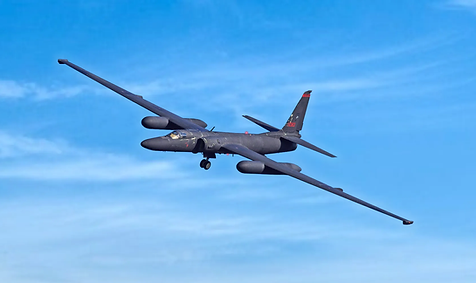

Testing began in 1955 under extraordinary secrecy.
Pilots arriving at Groom Lake often used false identities. Aircraft components were transported discreetly, and employees were instructed never to discuss their work.
The U-2 proved remarkably successful. Once operational, it conducted surveillance flights over the Soviet Union, providing intelligence that transformed American understanding of Soviet military capabilities.
Ironically, the unusual appearance and unprecedented altitude of the U-2 may have contributed to the rise of UFO sightings during the 1950s. Commercial airline pilots and civilians frequently observed the aircraft reflecting sunlight at extreme altitudes and reported strange objects in the sky.
Many UFO reports investigated by government agencies later corresponded to classified U-2 operations.
The A-12 Oxcart Program
Success with the U-2 led to even more ambitious projects.
The CIA sought an aircraft capable of flying faster and higher while remaining difficult to detect. This effort produced the A-12 Oxcart.
The aircraft represented a revolutionary leap in aerospace engineering. Constructed primarily from titanium and capable of exceeding Mach 3, it was unlike anything previously built.

Testing at Area 51 expanded dramatically during the early 1960s.
New hangars were constructed. Runways were lengthened. Security measures intensified.
Pilots reported experiencing conditions few humans had ever encountered. At speeds exceeding 2,000 miles per hour, temperatures on parts of the aircraft became hot enough to alter metal properties.
The A-12 eventually evolved into one of the most famous aircraft ever built: the SR-71 Blackbird.
The SR-71 Blackbird
The SR-71 Blackbird remains one of the greatest achievements in aviation history.
Capable of sustained speeds exceeding Mach 3 and operating at altitudes above 85,000 feet, the aircraft could outrun virtually
every missile and interceptor of its era.
Much of its development and testing occurred at Area 51.

Pilots frequently described the aircraft as operating on the edge of possibility. Its engines functioned partly like jet engines and partly like ramjets. Specialized fuel systems and exotic materials were required simply to survive flight conditions.
For years, sightings of Blackbirds contributed to UFO reports. Witnesses observing a dark triangular or elongated object moving at extraordinary speed often had no conventional explanation.
The secrecy surrounding the aircraft ensured that many sightings remained unexplained until the program became public decades later.
Stealth Technology Revolution
Perhaps Area 51's most significant contribution to military history was its role in developing stealth technology.
By the 1970s, radar systems had become increasingly sophisticated. Traditional aircraft were becoming more vulnerable to detection.
Researchers pursued a radical solution: design aircraft that would be nearly invisible to radar.
This concept led to the development of the Have Blue demonstrator and eventually the F-117 Nighthawk stealth fighter.
Testing occurred under intense secrecy at Area 51.
Observers occasionally reported strange angular aircraft unlike anything publicly known. These sightings helped fuel speculation about alien technology because the aircraft appeared so unconventional.
When the F-117 was finally revealed publicly in the late 1980s, many previously mysterious sightings suddenly had a plausible explanation.
Security Measures
Area 51's security is legendary.
Warning signs surround the perimeter, informing visitors that photography and trespassing are prohibited.
Electronic surveillance systems monitor approaches to the base.
Security personnel, often referred to by enthusiasts as "cammo dudes," patrol the region in unmarked vehicles.
The restricted airspace above Area 51 is among the most tightly controlled in the world.
Unauthorized aircraft entering the area may be intercepted immediately.
Employees historically traveled to the facility aboard unmarked commuter aircraft departing from a private terminal in Las Vegas.
Aviation enthusiasts nicknamed these aircraft "Janet" flights.
These daily flights transport workers between Las Vegas and classified facilities throughout Nevada.
Government Secrecy and Denial
One of the most remarkable aspects of Area 51's history is the government's long-standing refusal to acknowledge its existence.
For decades, official maps omitted references to the facility.
Government officials routinely declined to discuss operations conducted there.
This secrecy intensified public curiosity.
The absence of official information created fertile ground for speculation. Every unusual sighting, leaked photograph, or rumor became part of an expanding mythology.
Not until 2013 did the CIA officially acknowledge Area 51's existence through declassified documents related to the U-2 program.
For many observers, the admission confirmed what had long been obvious. Yet it also raised new questions about what activities remained classified.
UFO Connections
No discussion of Area 51 is complete without examining its association with UFOs.
Beginning in the late twentieth century, Area 51 became central to countless extraterrestrial theories.
According to various claims:
-
Crashed alien spacecraft were transported there.
-
Reverse-engineering programs studied extraterrestrial technology.
-
Alien bodies were stored in underground facilities.
-
Joint human-alien projects occurred on site.
-
Secret propulsion systems were developed from recovered UFOs.
No verifiable evidence has emerged supporting these claims.
Nevertheless, the secrecy surrounding the base has ensured that such theories remain popular.
Many UFO researchers argue that the government's history of deception regarding classified projects makes public skepticism understandable.
Others contend that Area 51's UFO reputation serves as a convenient distraction from genuine military programs.
The Bob Lazar Story
Perhaps no individual contributed more to Area 51's UFO mythology than Bob Lazar. In 1989, Lazar claimed he had worked at a facility known as S-4 near Area 51.

According to his account, he participated in efforts to reverse-engineer extraterrestrial spacecraft. He described saucer-shaped craft, anti-gravity propulsion systems, and a mysterious element later associated with Element 115. Supporters view Lazar as a whistleblower revealing hidden truths. Critics point to inconsistencies in his educational and employment history. The controversy remains unresolved and continues to generate debate among UFO enthusiasts.
The Internet Era and the Storm Area 51 Event
In 2019, Area 51 once again entered international headlines.
A Facebook event titled "Storm Area 51, They Can't Stop All of Us" attracted millions of responses.


The event jokingly proposed that participants could overwhelm security and discover the truth about extraterrestrials.
Although authorities warned against trespassing, the gathering evolved into a festival-like event rather than a mass invasion.
Only a small number of visitors approached restricted areas.
The incident demonstrated Area 51's enduring hold on the public imagination decades after its creation.
Modern Operations
Today, Area 51 continues to function as a highly classified testing facility.
While details remain secret, analysts generally believe the base supports:
-
Experimental aircraft development
-
Advanced drone testing
-
Electronic warfare research
-
Radar evaluation
-
Next-generation aerospace technologies
Satellite imagery periodically reveals new hangars, runway modifications, and construction projects.
Observers continue to speculate about what technologies may currently be under development.
Given the facility's historical role in producing revolutionary aircraft, it is reasonable to assume that significant classified programs remain active.
Conclusion
Area 51 occupies a unique position at the intersection of military history, technological innovation, government secrecy, and popular mythology. Established during the Cold War to support the development of advanced reconnaissance aircraft, it evolved into one of the world's most important aerospace testing facilities. Revolutionary aircraft such as the U-2, A-12, SR-71, and F-117 were developed and refined there, reshaping modern warfare and intelligence gathering.
At the same time, extraordinary secrecy transformed the base into a cultural phenomenon. The lack of official information encouraged speculation about UFOs, extraterrestrial technology, and hidden government programs. Whether viewed as a birthplace of aerospace innovation or as the center of enduring conspiracy theories, Area 51 continues to fascinate millions of people around the world.
More than seventy years after its creation, the installation remains one of the most recognizable secret facilities in history. Its legacy reflects both humanity's pursuit of technological advancement and its enduring fascination with mysteries hidden beyond public view.