
Foo Fighters
During World War II, Allied pilots began reporting something that defied easy explanation—mysterious lights and fast-moving glowing objects trailing their aircraft across both the European and Pacific theaters. These strange aerial encounters would come to be known as “foo fighters”, one of the earliest and most intriguing wartime UFO phenomena on record.
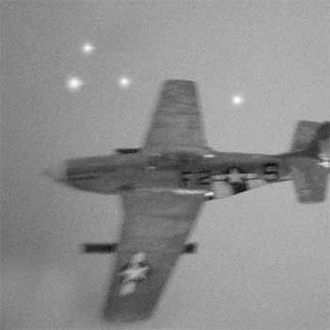
The term originated with the U.S. 415th Night Fighter Squadron, which began formally documenting sightings in November 1944. Pilots described glowing spheres—red, orange, white, or amber—darting alongside them at high speed, sometimes pacing their aircraft with apparent intelligence, other times executing sudden maneuvers before vanishing into the night sky. Many aircrews initially believed they were encountering secret enemy weapons.
Despite their persistence, the objects never displayed hostile behavior and could not be outrun, shot down, or clearly identified.
As reports mounted, military intelligence explored conventional explanations. The postwar Robertson Panel suggested possibilities ranging from electrostatic effects similar to St. Elmo’s fire, to electromagnetic phenomena, to simple optical illusions caused by ice crystals. Yet none of these fully accounted for the consistency and global nature of the reports.
The Origin of the Name
The phrase “foo fighter” itself has a surprisingly human origin. It traces back to cartoonist Bill Holman’s “Smokey Stover” comic strip, where the playful nonsense word “foo” frequently appeared. A radar operator in the 415th, Donald J. Meiers—an avid reader of the strip—borrowed the term during a particularly intense debriefing.
After witnessing a red glowing object seemingly chase their aircraft through evasive maneuvers, Meiers reportedly slammed a comic strip on the desk and exclaimed, “It was another one of those foo fighters!” The name stuck almost immediately among the squadron.
Originally, the term was even more colorful—informally used as “f***ing foo fighters”—before being sanitized for official records and later press coverage. By December 1944, journalists had adopted the cleaned-up version.
Alternative theories suggest the word may have been influenced by the French feu (“fire”) or even the military slang acronym FUBAR, though the Smokey Stover connection remains the most widely accepted origin.
Wartime Sightings Across the Globe
The phenomenon was not isolated. RAF crews had reported unexplained lights as early as 1942, with similar encounters continuing through 1944. American night fighter crews in Belgium and Western Europe began reporting them in large numbers by late 1944.
Descriptions were strikingly consistent:
-
glowing spheres or “balls of fire”
-
colors ranging from red and orange to green and white
-
rapid acceleration, sudden directional changes, and formation flying
-
behavior suggesting intelligent control, yet no aggression

Some pilots compared them to “Christmas tree lights” dancing in formation with their aircraft before abruptly disappearing.
Interestingly, similar reports came from German and Japanese pilots as well—suggesting a phenomenon not confined to one side of the war.
In the Pacific Theater, pilots described a related but slightly different phenomenon: large fiery spheres that sometimes hung motionless in the sky or followed aircraft at a distance. Some speculated a link to Japan’s fire balloon campaign, though no connection was ever confirmed.
Official Attention and Media Coverage
On December 13, 1944, the Supreme Headquarters Allied Expeditionary Force in Paris issued a press release describing the sightings as a possible “new German weapon.” The story quickly spread through major outlets, including The New York Times, New
York Herald Tribune, and the Daily Telegraph.
By January 1945, Time magazine had published an article titled “Foo-Fighter,” noting that Allied pilots had been encountering these glowing objects for over a month and remained unable to explain them.

Investigations and Theories
The 415th Night Fighter Squadron compiled multiple incident reports, which were escalated through military intelligence channels all the way to Supreme Headquarters Allied Expeditionary Force (SHAEF). Even the British Air Ministry admitted uncertainty, suggesting possibilities such as flak rockets or unidentified aircraft like the Me 262—but ultimately concluded the matter remained unresolved.

A later 1945 assessment stated:
“The whole affair is still something of a mystery and the evidence is very sketchy and varied.”
Postwar investigations by U.S. Air Force intelligence teams also failed to find evidence of any German or Japanese secret weapons program capable of producing the reported effects.
Still, alternative theories persisted. Some researchers proposed exotic wartime technologies such as self-guided “fireball” devices allegedly developed by Nazi SS units, though these claims remain unverified and widely disputed.
Other more grounded explanations include:
-
St. Elmo’s fire, a known atmospheric electrical discharge
-
ball lightning
-
optical illusions or reflection effects at high altitude
-
pilot disorientation or vertigo under night combat conditions
Even U.S. Navy research into nighttime aviation perception concluded that many “anomalous events” may stem from the limitations of human perception in extreme flight conditions rather than external physical objects.
Enduring Mystery
Despite decades of analysis, no definitive explanation has ever fully accounted for all foo fighter reports. What remains is a consistent pattern of credible military witnesses describing intelligent, structured aerial phenomena—appearing across continents, witnessed by multiple nations, and documented in real-time wartime conditions.
In modern terms, many researchers now view foo fighters as a historical precursor to what is today called UAP (Unidentified Aerial Phenomena)—suggesting that the mystery didn’t begin in the modern era… it was already in the skies during World War II.