Case Credibility Rating System
★★★★★ Very Low
★★★★★ Low
★★★★★ Moderate
★★★★★ High
★★★★★ Exceptional
Primarily anecdotal, anonymous or unverifiable witnesses, story surfaced long afterward, little/no contemporary documentation, serious inconsistencies, or evidence of fabrication.
Identifiable witness or source, but evidence is weak. Limited corroboration, secondhand reporting, questionable documentation, or plausible conventional explanations significantly weaken the case.
Credible identifiable witnesses and reasonable documentation. Some independent corroboration may exist, but important uncertainties remain or conventional explanations cannot be confidently excluded.
Multiple credible or independent witnesses, strong contemporary documentation, and/or supporting photographic, radar, physical, military, police, or scientific evidence. Conventional explanations have been investigated but remain inadequate or disputed.
Exceptionally well-documented case involving multiple independent sources and several mutually supporting forms of evidence. Records have strong provenance, major details are independently corroborated, and extensive investigation has failed to produce a convincing conventional explanation.

1500s
Nuremberg Celestial Phenomenon
April 14, 1561 - Nuremberg, Germany
The Nuremberg Celestial Phenomenon of April 14, 1561, is one of the most famous and controversial historical sky events ever recorded. It took place over the city of Nuremberg in the former Holy Roman Empire and was documented by German printer and artist Hans Glaser in a widely circulated illustrated broadsheet.
What Was Reported?
According to Glaser's account, between about 4 and 5 a.m. at sunrise, many residents witnessed an extraordinary display in the sky. The report describes:
-
Blood-red semicircular shapes around the Sun.
-
Numerous spheres, globes, crosses, rods, and cylindrical objects.
-
Objects emerging from large tube-like forms.
-
The objects appearing to maneuver and "fight" one another.
-
A large black spear- or triangular-shaped object appearing afterward.
-
Some objects reportedly falling toward the ground in smoke.
-
The spectacle lasting for roughly an hour.
The famous woodcut illustration depicts a chaotic aerial scene filled with circles, crosses, crescents, cylinders, and a large dark object hovering above the city.
The Religious Interpretation
In the 16th century, unusual celestial events were commonly viewed as messages from God. Glaser concluded his broadsheet by urging readers to repent and seek divine forgiveness, interpreting the phenomenon as a heavenly warning rather than an extraterrestrial event.
At the time, broadsheets frequently reported comets, eclipses, celestial signs, and other wonders in highly symbolic and religious language.
UFO Interpretation
The event became famous among UFO researchers in the 20th century. Some ufologists argue that the report resembles:
-
Multiple structured flying objects.
-
Aerial maneuvers beyond known technology.
-
A possible "battle" between unknown craft.
-
A large triangular or spear-shaped vehicle appearing afterward.
Because the account predates modern aviation by centuries, believers often cite it as evidence that UFO phenomena have been observed throughout human history. The event is sometimes called the "Battle of Nuremberg."
Skeptical Explanations
Most historians and atmospheric scientists do not consider the event evidence of extraterrestrial spacecraft. Proposed explanations include:
Sun Dogs and Halo Effects
The leading explanation is a complex atmospheric display involving:
-
Sun dogs (parhelia)
-
Solar halos
-
Ice crystals in the atmosphere
-
Crepuscular rays and shadows
Such phenomena can produce bright colored spots, arcs, pillars, and geometric patterns around the Sun that may appear dramatic and unusual.
Artistic Exaggeration
Historians note that 16th-century broadsheets were not objective journalism. Artists often combined symbolism, eyewitness reports, religious interpretation, and imagination into a single dramatic image. Some scholars suggest Glaser may have merged several atmospheric observations into one sensational illustration.


Carl Jung's View
Psychologist Carl Jung discussed the event in his 1958 book Flying Saucers: A Modern Myth of Things Seen in the Skies. Jung argued that whatever occurred was likely interpreted through the symbolic and religious mindset of the era, emphasizing the psychological meaning of the imagery rather than treating it as literal spacecraft.
Why It Remains Important
The Nuremberg event remains significant because:
-
It is one of the earliest detailed mass-sighting reports in European history.
-
It includes a surviving contemporary illustration.
-
It is frequently cited in discussions of historical UFO sightings.
-
No explanation has achieved universal acceptance.
Whether viewed as a rare atmospheric phenomenon, a religiously interpreted celestial event, or evidence of an unexplained aerial mystery, the Nuremberg Celestial Phenomenon remains one of the most fascinating historical cases in UFO lore.
The Basel Celestial Phenomenon
August 7th, 1566 - Basel, Switzerland
The Basel Celestial Phenomenon was a series of strange sky events reported over the city of Basel during the summer of 1566. Along with the 1561 Nuremberg event, it is one of the most famous historical "sky battle" reports and is frequently cited in UFO literature.
What Happened?
The events were recorded in a broadsheet created by printer Samuel Apiarius and writer Samuel Coccius. Witnesses reported a sequence of unusual celestial displays on July 27–28 and August 7, 1566.
According to the account:
-
An unusually dark and reddish sunset appeared over Basel.
-
Following a lunar eclipse, the Sun reportedly rose blood-red.
-
Numerous black and red spherical objects appeared in the sky.
-
The spheres seemed to move rapidly and "fight" with one another.
-
Some objects reportedly vanished, changed color, or appeared to burn out.
The woodcut illustration accompanying the report shows dozens of dark spheres surrounding the Sun, creating the impression of an aerial battle.
Contemporary Interpretation
Like many unusual celestial events of the 16th century, the phenomenon was interpreted as a divine warning. Europe was experiencing significant religious and political turmoil during the Protestant Reformation, and unusual events in the heavens were often viewed as signs from God. Coccius urged readers to repent and reflect on the meaning of the spectacle.
UFO Interpretation
Modern UFO researchers often compare the Basel event to the earlier Nuremberg Celestial Phenomenon of 1561. Some ufologists suggest the report describes:
-
Multiple structured aerial objects.
-
Intelligent maneuvering.
-
A large-scale conflict between unknown craft.
-
A mass sighting witnessed by many people simultaneously.
Because the report predates aircraft by centuries, believers argue it may represent an early historical UFO encounter.
Skeptical Explanations
Most historians and atmospheric scientists favor natural explanations.
Atmospheric Optics
The leading explanation involves unusual atmospheric conditions producing:
-
Solar halos
-
Sun dogs (parhelia)
-
Ice-crystal reflections
-
Atmospheric scattering during sunrise and sunset
Such effects can create bright colored spots, circles, and moving visual distortions around the Sun that might be interpreted dramatically by observers.
Symbolic Artwork
The famous woodcut was not intended as a modern photograph-like record. Sixteenth-century broadsheets often combined eyewitness testimony with religious symbolism and artistic interpretation, potentially exaggerating what witnesses actually saw.


Comparison with Nuremberg (1561)
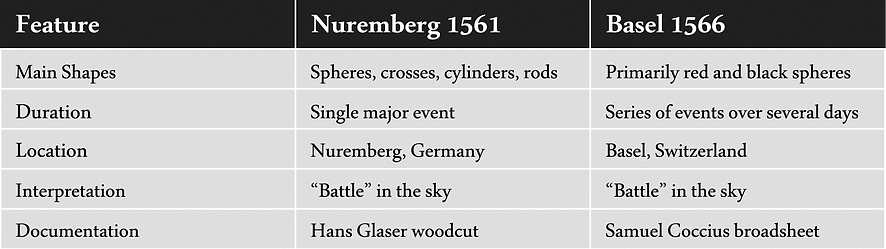
Both events were recorded within five years of each other and are often discussed together as the most famous "celestial battles" of Renaissance Europe.