★★★★★★★★★★ — High Credibility
Score: 7/10
This requires an important distinction. I am not rating the credibility of the claim that the Sun physically moved, that the event was supernatural, or that a UFO was present. I am rating the historical evidence that a large crowd experienced and reported an extraordinary visual phenomenon at Fátima.
On that narrower question, the evidence is unusually strong.
Category
Witness Reliability:
Contemporary Documentation:
Independent Corroboration:
Physical/Instrumental Evidence:
Resistance to Conventional Explanation:
Score
2/2
2/2
2/2
0/2
1/2
Assessment
A very large and diverse crowd was present, including believers, skeptics, journalists and professionals.
Excellent. Journalists attended specifically because an event had been predicted, and newspapers reported what happened immediately afterward.
Numerous observers reported unusual solar effects, although their descriptions varied and some apparently saw nothing unusual.
No astronomical instrument recorded the Sun moving, and claims of rapidly dried clothing or ground weren't scientifically measured.
Solar afterimages, atmospheric optics and psychological expectation plausibly explain substantial portions of the testimony, although reconstructing exactly what occurred is difficult.

The Miracle of the Sun
May 13 - October 13 1917 - Fátima, Portugal
The Miracle of the Sun is one of the most famous and controversial mass-witness events in modern history. It culminated on October 13, 1917, near Cova da Iria, outside the Portuguese village of Fátima, after six months of reported apparitions of the Virgin Mary to three shepherd children. To believers, it remains one of the most remarkable Marian miracles ever recorded. To skeptics, it represents an extraordinary example of unusual atmospheric conditions, optical effects, psychological expectation, or collective perception. Regardless of how it is interpreted, the event remains one of history’s best-known unexplained public phenomena.
The story began on May 13, 1917, when three children were tending sheep near Fátima. They were ten-year-old Lúcia dos Santos, nine-year-old Francisco Marto, and seven-year-old Jacinta Marto. According to their account, they encountered a radiant woman standing above a small holm oak tree. The children later identified her as the Virgin Mary.
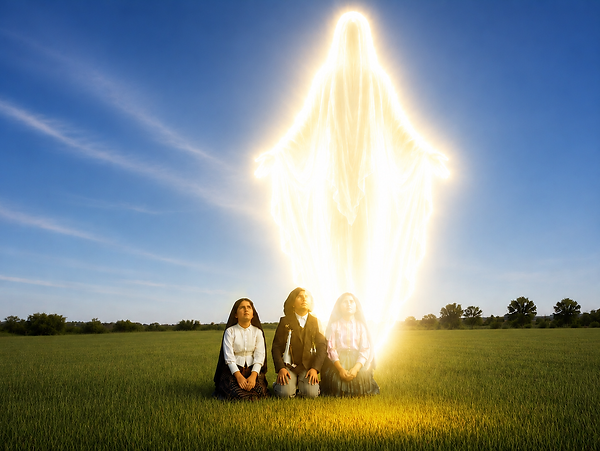
The woman asked them to return to the same location on the thirteenth day of each month for six months. She encouraged prayer, repentance, sacrifice, and the daily recitation of the Rosary for peace and for an end to the First World War.
News of the apparitions spread rapidly throughout Portugal. Some people immediately believed the children, while others accused them of lying, imagining the encounters, or being manipulated by religious adults. Portugal was governed at the time by a strongly anti-clerical republican administration, and local officials were suspicious of the growing religious excitement surrounding the children.
In August 1917, the local administrator, Artur de Oliveira Santos, detained the children and attempted to force them to reveal the secrets they said the Lady had given them. He reportedly threatened them with imprisonment and even suggested that they might be boiled in oil. Despite their fear, the children refused to deny their experiences or reveal the secrets. Because they were detained on August 13, they were unable to reach Cova da Iria on the expected date. They later reported seeing the apparition on August 19 at Valinhos, a location near their homes.
As the monthly apparitions continued from May through October, the number of people gathering at Cova da Iria increased dramatically. What began with a small group of curious villagers eventually attracted thousands of pilgrims, skeptics, journalists, clergy members, and government observers.
During one of the apparitions, Lúcia announced that the Lady had promised to perform a miracle in October so that everyone would believe. This prediction became widely known through newspapers, religious networks, and word of mouth. It was especially significant because the children had publicly announced both the location and approximate date of the promised sign months before it was expected to occur.
On the morning of October 13, 1917, enormous crowds travelled to Cova da Iria despite severe weather. Heavy rain had fallen throughout the night and continued into the morning, turning the fields into deep mud. Estimates of the crowd vary considerably, but many accounts place the number between 30,000 and 70,000 people, while some estimates rise as high as 100,000.
The gathering included farmers, laborers, priests, physicians, government officials, journalists, photographers, religious pilgrims, atheists, and skeptics. Some came hoping to witness a miracle, while others expected the children’s prediction to fail and the entire affair to be exposed as a fraud.
At approximately noon, Lúcia reportedly asked the crowd to close their umbrellas. According to the children, the Lady then appeared above the holm oak for the final time. Lúcia said that the figure identified herself as Our Lady of the Rosary and asked that a chapel be built at the site. She again urged people to pray the Rosary and to amend their lives.
The children also reported seeing a series of visions in the sky, including images associated with the Holy Family, Saint Joseph, the Virgin Mary, and Jesus Christ. Most of the people in the crowd did not claim to see the Lady or these religious figures. Instead, they reported witnessing an extraordinary phenomenon involving the Sun.
Descriptions varied from witness to witness, but many accounts shared several major features. The rain reportedly stopped, the clouds began to break apart, and the Sun appeared through the overcast sky. Witnesses said that it no longer looked like an ordinary Sun. Instead, it appeared as a pale, silver-colored, pearl-like, or frosted disc that could be viewed directly without causing the usual pain or glare.

Many people reported that the disc began to rotate or spin rapidly. Some said that it threw out brilliant beams of colored light, causing the landscape, clouds, trees, people, and surrounding buildings to appear in shifting shades of yellow, blue, violet, red, green, and other colors.
Witnesses described the Sun as trembling, zigzagging, or moving erratically across the sky. After appearing to spin and change colors, it reportedly seemed to break free from its normal position and plunge toward the Earth. The crowd reacted with panic. Some people screamed, prayed, confessed their sins, fell to their knees, or believed that the end of the world had arrived.
The object then appeared to stop, reverse its movement, and return to its normal position in the sky. The entire solar display was generally said to have lasted approximately ten minutes, although individual estimates differed.
After the event, many witnesses claimed that the muddy ground had become unexpectedly dry. Some also said that their clothing, which had been soaked by hours of rain, was suddenly dry or nearly dry. This detail became one of the most frequently repeated elements of the story, although later investigators have debated how widespread or reliable these reports were.
The event attracted particular attention because journalists had attended the gathering. Some of them were skeptical of the children and expected nothing unusual to happen. The Portuguese newspaper O Século, which was generally secular and critical of organized religion, published a prominent account by journalist Avelino de Almeida. He described the enormous crowd and reported that people had seen the Sun tremble, make unusual movements, and appear to dance in the sky.
Other newspapers also covered the event, allowing reports of Fátima to spread throughout Portugal and later across Europe. The existence of contemporary newspaper coverage helped distinguish the Miracle of the Sun from legends that developed only many years after an alleged event.
Despite the dramatic testimony, no astronomical observatory reported that the physical Sun had moved from its normal position. Such a movement would have produced catastrophic consequences and would have been visible across a vast portion of the planet. There were also no widespread reports of the same phenomenon from observers far outside the Fátima region.
For this reason, scientists, historians, psychologists, and skeptics have proposed a variety of natural explanations. One possibility is that people experienced optical effects after staring directly at the Sun. Prolonged solar observation can produce retinal afterimages, changes in perceived color, apparent motion, pulsation, and the illusion that the Sun is spinning or moving.
Atmospheric conditions may also have contributed. Thin cloud layers, moisture, ice crystals, dust, or unusual variations in air density can alter the appearance of the Sun and create halos, color effects, or distortions. Some researchers have suggested that a parhelion, commonly known as a sundog, or another unusual atmospheric optical phenomenon may have been involved.
Psychological expectation may also have influenced the witnesses. Thousands of people had gathered after being told that a miracle would occur at a particular time and place. In such emotionally intense circumstances, suggestion, religious excitement, crowd behavior, and differing individual perceptions could have shaped how people interpreted an unusual but natural event.
However, no single skeptical explanation fully accounts for every reported detail. Witnesses did not all describe exactly the same thing, and some people present reportedly saw nothing unusual at all. The claims that the ground and clothing dried rapidly are also difficult to evaluate because the temperature, wind conditions, duration of the rain, and exact state of the clothing were not scientifically measured.
Believers argue that the diversity of the crowd strengthens the case for a genuine miracle. The witnesses included skeptics, journalists, educated professionals, and people located several miles from the main gathering. They also emphasize that the event had been predicted in advance and that it occurred at the date and location announced by the children.
The Catholic Church conducted a lengthy investigation into the apparitions and related events. In 1930, the bishop of Leiria-Fátima officially declared the apparitions worthy of belief and permitted public devotion to Our Lady of Fátima. This declaration did not mean that every reported detail had been scientifically verified, but it indicated that the Church considered the apparitions consistent with Catholic faith and worthy of religious acceptance.
Catholics are not required to believe in private revelations such as Fátima in the same way that they are expected to accept central doctrines of the faith. Nevertheless, the Fátima apparitions became enormously influential within modern Catholicism.
Francisco Marto died in 1919, and Jacinta Marto died in 1920, both during the influenza pandemic. They were canonized as saints by Pope Francis in 2017. Lúcia dos Santos later became a Carmelite nun and lived until 2005. She wrote several memoirs describing the apparitions, the secrets of Fátima, and the events surrounding the Miracle of the Sun.
The site at Cova da Iria eventually developed into the Sanctuary of Our Lady of Fátima, one of the most important Catholic pilgrimage destinations in the world. Millions of people visit the sanctuary, particularly around May 13 and October 13, the anniversary dates associated with the first apparition and the Miracle of the Sun.
The event has also attracted attention outside religious studies. Some UFO writers have compared the witness descriptions to reports of unidentified aerial phenomena. They point to accounts of a bright disc, rapid spinning, changing colors, erratic movement, and an apparent descent toward the crowd.
A minority of researchers have suggested that the witnesses may have observed an unexplained aerial object that was interpreted
through the religious beliefs and cultural expectations of early twentieth-century Portugal. Under this theory, the Virgin Mary narrative may have been the religious interpretation of a strange physical phenomenon.
There is no direct evidence proving a UFO explanation, however, and the comparison is based mainly on similarities in witness descriptions. Most historians treat Fátima primarily as a religious, cultural, and psychological event rather than a UFO case.
For believers, the Miracle of the Sun is powerful because it was predicted months in advance, witnessed by tens of thousands of people, observed by both believers and skeptics, and recorded in contemporary newspapers. For skeptics, the lack of astronomical confirmation, the variations between witness accounts, and the known effects of staring at the Sun suggest that natural and psychological explanations are more likely.
More than a century later, the Miracle of the Sun remains one of history’s most famous mass-witness events. Whether it was a genuine divine miracle, an unusual atmospheric display, a product of optical and psychological effects, an unexplained aerial phenomenon, or some combination of these possibilities, the events at Fátima on October 13, 1917, continue to inspire religious devotion, historical investigation, scientific debate, and speculation.